What Survives the 07:42: A No-Fuss CBD Bag Audit for UK Commuters

Photo: flat lay commuter backpack contents train ticket water bottle small supplement tub, via cdn.arstechnica.net
Somewhere in a hallway near you is a tote bag holding a laptop, a charger, a flattened cereal bar and a bottle of CBD oil that hasn't left the flat since March. That isn't a willpower problem. It's a design problem. Most CBD products are built for a bathroom shelf rather than the Northern line at 07:42, and once you start judging them by commuter standards, the shortlist gets brutally short.
So treat this as an audit rather than a shopping list. Four formats, four tests, no hype.
Four tests that do most of the work
Before anything earns a slot in your bag, run it past these:
- Portability. Does it slip into a rucksack pocket, or does it demand its own compartment?
- Discretion. Would you be relaxed using it on a packed carriage or at a shared desk?
- Storage. Does it mind heat, light, or being rattled about for an hour twice a day?
- Cost per serving. Not the shelf price — the price of one actual use.
That fourth test is where a lot of confident marketing quietly falls apart, so we'll come back to it.
Oils: the format everyone starts with, and the one that leaks
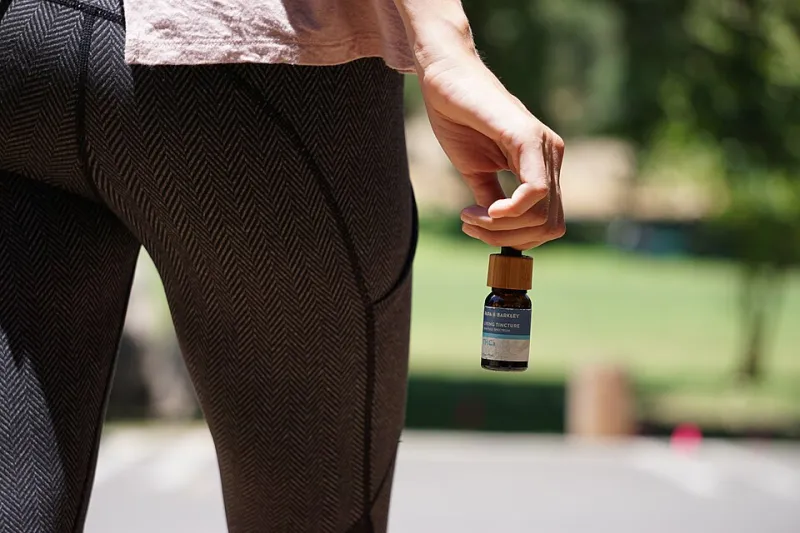
Tinctures are the default first purchase, and it's easy to see why: they're flexible, easy to adjust drop by drop, and widely stocked — Holland & Barrett, Boots, the independent shop near the station.
The commuter problem is mechanical. A 10ml or 30ml glass bottle with a dropper is a small, top-heavy object living in a bag that gets swung, dropped and wedged under seats. Even a well-made cap can weep slightly when the bottle ends up on its side under a coat. Then there's the social side: administering drops under your tongue on a busy train is not a subtle look, and doing it at your desk invites questions you may not want at 9am.
Verdict: workable if you accept limits. One small bottle, kept upright in a zip pouch, used before you leave the house or at lunch rather than mid-carriage. Don't decant into an unlabelled travel bottle — you'll lose the batch number, the strength and the best-before date, which are the three things you'd actually want to know later.
Capsules: unglamorous, and that's exactly the point
Capsules look boring next to a dropper bottle. That's their selling point. No taste, no liquid, no leak, no explaining yourself on public transport. A small tub or blister pack disappears into a bag pocket and survives being sat on.
The thing to check is dose per capsule rather than dose per tub. Some products list a total milligram figure that's spread across two capsules, which changes your cost per serving considerably. Read the back panel, not the front.
Verdict: the strongest candidate for a work bag, provided you know the milligrams in one capsule and the number of capsules in the pack.
Balms and topicals: right bag, wrong bag
A balm stick has real advantages — solid, sealed, spill-proof, no need to take it with water. But it's a topical product, so the questions shift: does it leave a residue on your hands, does it smell strongly, and would you want it in a shared office fridge or a gym locker next to someone's towel?
Verdict: good for a desk drawer, gym bag or coat pocket. Less good as the single item you rely on away from home, and pointless if what you were after was something to swallow.
Drinks and shots: heavy, chilled, and priced accordingly
Canned CBD drinks are pleasant and increasingly common in UK chillers, but they're a poor commuter companion. They weigh more than everything else combined, they don't enjoy being warm, and a can in a rucksack next to a laptop is a genuine risk.
Cost per serving is the sticking point. A £2.50 can with a modest milligram figure works out far pricier per milligram than a bottle you dose yourself. Some are also mostly flavoured water with a token amount of extract — fine as a drink, misleading as a supplement.
Verdict: buy one to try at home. Don't build a kit around them.
What to leave at home
A short list of things that rarely justify the space: the giant 100ml bottle, anything that needs refrigeration once opened, homemade decants with no label, products whose dosing instructions you'd have to look up on your phone before each use, and any format you bought on impulse because the packaging was nice.
A weekday kit that actually holds together
Three items is plenty:
- One primary format — a capsule tub or a small oil bottle, in a zip pouch, upright.
- One optional extra — a balm stick if you already use one, otherwise nothing.
- A note on your phone — product name, strength in mg, serving size, batch or best-before date, and the date you opened it. Takes ninety seconds and answers most questions a pharmacist or GP might ask later.
That's it. No travel case, no dosing diary, no laminated card.
The cost-per-serving sum nobody runs
Divide the price by the number of servings in the pack, not by the number of days you hope it lasts. A £30 bottle containing 200 drops at five drops a serving is about 75p a go. A £45 tub of 60 capsules taken one a day is also 75p. A £2.50 canned drink with a small milligram dose might be five times that per milligram. Same shelf, very different maths.
Run this sum before you buy, and the bag problem often solves itself — the formats that survive a commute tend to be the ones that also survive a budget review.
The takeaway
A commuter CBD kit should be small, sealed and slightly dull. If it needs its own pouch, a reminder alarm and a dedicated pocket, it's probably not coming with you. Pick one format that travels well, know your cost per serving, and leave the rest on the shelf.