The Pipette Is Not a Teaspoon: How to Read CBD Oil Numbers Without Guesswork
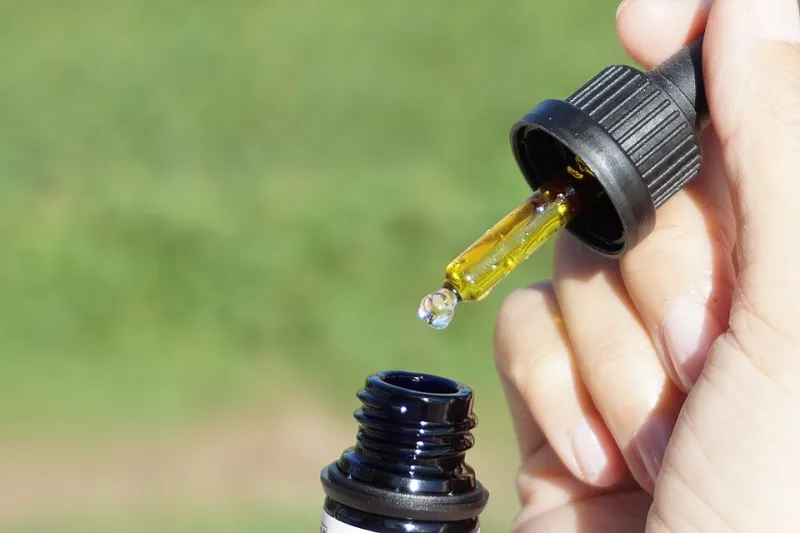
Photo: Elsa Olofsson, CC BY 2.0, via Wikimedia Commons
CBD oil comes with a pipette, a label full of numbers and a habit of making the whole thing feel more precise than it really is. You squeeze, a few drops land under your tongue, and you get on with your day. The trouble starts when you try to repeat that routine, compare one bottle with another, or answer the very reasonable question: how much am I actually taking?
Why 'two drops' is a shaky unit
A drop is not a standard measurement. The size of a drop depends on the liquid itself, the angle of the pipette, how hard you squeeze the bulb, the temperature of the oil and whether the bottle has been sitting upright or on its side. Two drops from one bottle may not match two drops from another. Even two drops from the same bottle can vary if you are rushing before work.
That does not mean drops are useless. They are a familiar way to talk about a small amount. The problem is using them as your only record. If last week's routine was 'a couple of drops' and this week's is 'a bit more', you have not really changed anything you can measure. You have changed a mood.
Milligrams and millilitres are doing different jobs
The label usually shows two kinds of number, and they are easy to blur together.
Milligrams (mg) tell you how much CBD is in the bottle in total. This is the strength figure shoppers tend to notice: 500mg, 1000mg, 2000mg and so on.
Millilitres (ml) tell you the volume of liquid in the bottle. A small bottle might hold 10ml; a larger one might hold 30ml.
Those two numbers only become useful when you put them together. A 10ml bottle containing 1000mg of CBD is not the same concentration as a 30ml bottle containing 1000mg. The first has 100mg of CBD in each millilitre. The second has about 33mg per millilitre. Same headline strength, very different amount per pipette full.
That is the first bit of bottle maths worth doing in the shop, or at the kitchen table before you open the box.
The simple sum that beats guesswork
You do not need a laboratory. You need one division and one multiplication.
-
Total CBD in the bottle ÷ total millilitres = milligrams per millilitre.
For example: 1000mg ÷ 10ml = 100mg per ml. -
Milligrams per millilitre × the amount you take in ml = the CBD in that serving.
If you take 0.5ml from that bottle, you are taking roughly 50mg.
This is why the pipette markings matter more than the drop count. Many pipettes have lines for 0.25ml, 0.5ml, 0.75ml and 1ml. Those lines are not perfect, but they are far more repeatable than 'two good squeezes'. Read the markings in daylight, hold the pipette upright and take your time. If the label gives a suggested serving, use that as your starting point rather than inventing your own.
Drops can still help — as a rough cross-check
People often ask how many drops are in a millilitre. A common working estimate is around 20 drops per ml, but treat that as a kitchen-table approximation, not a rule. Oils vary. Pipettes vary. Your squeeze varies.
If a bottle has 100mg per ml and you assume 20 drops per ml, each drop is roughly 5mg. If a different bottle has 33mg per ml, each drop is roughly 1.6mg. That helps explain why 'two drops' from two bottles can mean very different things. But it is not a reason to start counting drops with surgical seriousness. Use millilitres for your routine and drops only as a loose sanity check.
Keep a note that a normal person would actually keep
A CBD routine becomes much easier to think about when you have a small record. It does not need to be a spreadsheet. A note in your phone or a line in a notebook is enough.
Write down:
- the date you started the bottle;
- the product name and batch number if it is on the label;
- the total CBD in mg and the bottle size in ml;
- how much you take, in ml, and when;
- anything you notice, in plain words.
'Felt no different' is a useful note. So is 'took it after breakfast instead of before'. What you are building is a comparison, not a clinical trial. You are trying to avoid the classic trap of changing three things at once and then having no idea what changed.
Ask better questions before you buy
When you are standing in a shop or scrolling a UK retailer's page, the useful questions are not 'is this strong?' but 'how many milligrams per millilitre?' and 'what does the pipette mark show?' A shop assistant who can answer those is more helpful than one who says 'this one is popular'.
It also helps to remember what CBD products are and are not. In the UK, CBD is generally sold as a food supplement, not a medicine. It is not a treatment for a condition, and it is not a shortcut around proper advice. If you take prescription medicines, are pregnant or breastfeeding, or are under 18, speak to a pharmacist or GP before experimenting. That is not drama; it is just the sensible version of checking the label.
The takeaway: measure in millilitres, think in milligrams
The pipette is not a teaspoon, and 'two drops' is not a dose you can rely on. Read the bottle's total milligrams, divide by the millilitres, and use the pipette markings to keep your serving roughly consistent. Keep a short note. Ask what the numbers mean before you pay. That is enough maths for a kitchen table — and far better than another month of guessing.