Bottle, Bulb, Box: A Calm Clear-Out Guide for Finished CBD Kits
Photo: empty amber glass dropper bottle recycling kitchen counter UK, via 66.media.tumblr.com
There is a particular kind of kitchen shelf that builds up quietly: three amber bottles, one with a finger of oil left, a couple of empty ones you meant to deal with, a carton, a leaflet, and a dropper bulb rolling about at the back. As 2026 draws to a close and the January clear-out starts to loom, it is tempting to scoop the lot into one bag and hope for the best. Understandable. But your council may have other ideas.
The awkward truth is that there is no single UK answer to the empty CBD bottle question. Kerbside collections are run council by council, and what is accepted in one postcode can be turned away in the next. This is not a moral test. It is a sorting question, and the fix is usually a two-minute check rather than a deep dive into waste policy.
Start with your council's A-Z, not the bin
Most councils publish a recycling A-Z or a postcode checker on their website. Search your council name plus 'what goes in my bins' or 'recycling A-Z'. Then look up the specific items rather than the whole product. Try 'glass bottles', 'plastic caps', 'cardboard', 'foil' and 'compostable packaging'. If an item is not listed, treat that as a gentle no, not a challenge.
The useful rule of thumb is simple: if you are squinting at an item and guessing, it is probably general waste. One extra item in the rubbish bin is a small loss. A hopeful item in the recycling can contaminate a whole load, which is a bigger loss.
The amber bottle: glass, but not a free pass
CBD oils often arrive in small amber glass bottles. Glass is recyclable in many areas, but councils differ on what shape and colour they take at the kerbside. Some accept glass bottles and jars together. Some ask for colours to be separated. Some do not collect glass at the kerbside at all and rely on bottle banks.
Rinse the bottle so it is not sticky or oily, remove the dropper, and check your council's glass rules. Labels usually do not need to be scrubbed off for kerbside glass, but a quick rinse helps. If the bottle is broken, wrap it safely and check whether your council accepts broken glass at all. Many do not, because it is a handling risk.
The dropper: the bit most likely to scupper the sort
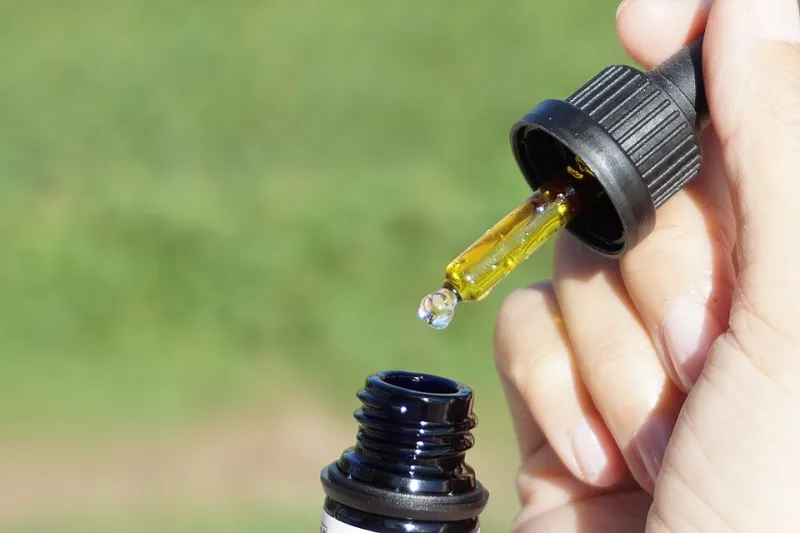
The dropper is where a lot of good intentions go wrong. The bulb is usually rubber or a soft plastic. The pipette itself may be glass or plastic. Neither is a reliable kerbside recycling item in most UK areas. Small rubber bulbs are especially awkward because they can jam sorting machinery or end up as contamination.
Take the dropper out before you deal with the bottle. In most cases, the bulb and pipette belong in general waste unless your council specifically lists them. Do not put the whole dropper into the glass recycling and hope it gets separated later. It probably will not, and it makes the glass stream dirtier.
Caps, seals and shrink wrap
Plastic caps are a mixed bag. Some councils accept plastic bottle caps if they are left on the bottle, because the cap is large enough to be captured in the sorting process. Others prefer caps off, especially if they are small or made of a different plastic. Plastic seals and shrink wrap around the neck are usually too small and too flimsy for kerbside recycling.
Check the cap specifically. If your council says caps go on, leave it on. If it says caps off, take it off. If it says nothing, general waste is the safer call. Small plastic rings and seals are not worth the gamble.
Cartons and inserts: usually the easy bit
Outer cartons, leaflets and paper inserts are often the least complicated part of a CBD kit. Flatten the carton, keep it clean and dry, and put it in paper and card recycling if your council collects that at the kerbside. Remove any plastic window, foam insert or magnetic closure first, because those are not paper.
If the carton is glossy, laminated or has a plastic film, check your council's card rules. Most will take ordinary printed cardboard. If the box is greasy or has oil on it, keep it out of the paper stream.
Compostable pouches and the 'eco' label trap
A pouch that says compostable is not automatically a kerbside recycling item. In fact, it usually is not. Many compostable pouches need industrial composting conditions, and some home-compostable ones still need a proper home heap rather than a food waste bin. Your council's food waste collection is not a catch-all for bioplastics.
Look for a certification mark and read what it actually covers. If it is not clearly accepted by your council and you do not have a home compost setup that suits it, put it in general waste. That feels counterintuitive next to a green leaf symbol, but wishcycling a compostable pouch into the wrong stream can do more harm than good.
Wishcycling: why a hopeful toss can cost more
Wishcycling is the habit of putting something in the recycling because you want it to be recyclable. It is very human. It is also the reason sorting centres spend time pulling rubber bulbs, small seals and compostable film out of streams where they do not belong. The result is not a recycled bottle. It is a slower, dirtier process and sometimes a rejected load.
The calmer approach is to accept that one item may need general waste. That is not a failure. It is the system working as well as it can with the rules your council has set.
A five-minute shelf audit
Gather the finished kit on a tea towel. Separate glass bottles, plastic caps, cardboard and the dropper parts. Rinse the glass. Check your council's A-Z for the two or three items you are unsure about. Put the clear recyclables in their usual indoor bin. Put the dropper bulb, small seals and any uncertified compostable pouch in general waste. Flatten the carton. Then wipe the shelf and start again with a clean slate.
If you have half-finished bottles rather than empties, that is a different job: check dates, store them sensibly and only keep what you will actually use. The empty-bottle question is just the last step in a routine, not a test of how green you are.
The bottom line
Your council's list beats any general rule you read online. In 2026, kerbside rules still vary enough that a bottle accepted in one town may be refused in the next. Check the A-Z, separate the dropper, rinse the glass, flatten the carton, and send the awkward bits to general waste when the answer is not clear. It is a small routine, but it makes the January clear-out a lot less sticky.